
Your Next Major Donor Is Probably Already in Your Database
Your top donors didn't fall out of the sky.
I've believed that for years.
Major donors aren't discovered. They're developed over time. The person giving you $50,000 usually started somewhere much smaller.
I've seen that firsthand at the organizations where I've worked, but recently I realized I'd never actually checked that assumption against the organizations I work with now.
So I did.
I looked at giving data from five arts and culture organizations, covering more than 1,100 donor records and more than $2 million in annual individual giving.
And the data backed up what I'd suspected, but it also showed me something I didn't expect.
First, the obvious part: individual giving is concentrated.
Across the five organizations, the median organization raised 67% of its individual giving from just 10 people.
At four of the five organizations, donors giving $1,000 or more accounted for more than 90% of individual giving dollars.
And those $1,000+ donors never made up more than about a third of the donor list.
Cool.
Concentration is real. We knew that.
But then I looked at who those top 10 donors were.
The top 10 isn't a fixed roster.
At each organization, 3–5 of the top 10 donors were new to that top 10 that year.
That's 30–50% turnover annually.
Which raised the question:
Where did those new top donors come from?
Across four of the five organizations, I found 16 donors who climbed into the top 10.
And 13 of them had already given the organization a gift the year before.
Their median prior-year gift?
$1,280.
Ten of the 13 had given less than $2,500.
They weren't strangers who suddenly appeared with a giant check.
They were already in the database.
They were already giving.
And then their giving changed dramatically.
On average, those 13 donors increased their prior-year gift by about 8x.
The individual examples are even more striking:
One donor went from $800 to more than $55,000.
Another went from $700 to more than $25,000.
Another went from $750 to just under $10,000.
Another went from $500 to $5,000.
Only three of the 16 donors who moved into the top 10 were completely new donors with no prior gift.
That reinforced the way I think about major donor prospecting.
Your next major donor does not need to be found.
They need to be developed.
They're probably already somewhere in your database.
They may be giving $500.
Or $1,000.
Or $2,000.
They may have been giving that amount for years.
And if your fundraising strategy is primarily built around reaching as many people as possible with the same broad appeal, there's a good chance you're missing the opportunity sitting right in front of you.
Because a donor database isn't just a list of people who have given you money.
It's a record of relationships that haven't necessarily reached their potential yet.
The question isn't only:
Who has the capacity to make a major gift?
It's also:
Who is already demonstrating that they care, and might be ready for a deeper relationship with us?
That's a very different prospecting exercise.
And it starts with the people you already know.
So here's my challenge:
Go find your next top 10 donor.
Look at the people already giving you four figures or less.
Look beyond their current gift.
Look at their history. Their engagement. Their connection to your mission. Their capacity. Their relationships with your organization.
Then ask yourself:
What would it take to move this relationship forward?
Move the relationship forward, and then when it’s time to ask for a gift, be bold enough to ask for more–you might just get it 😉
And if you want to see what that looks like in practice, this is a big part of the work we do with arts and culture organizations at Coastal Nonprofit Consulting: identifying the donors already in the database who have the potential to become something much more.
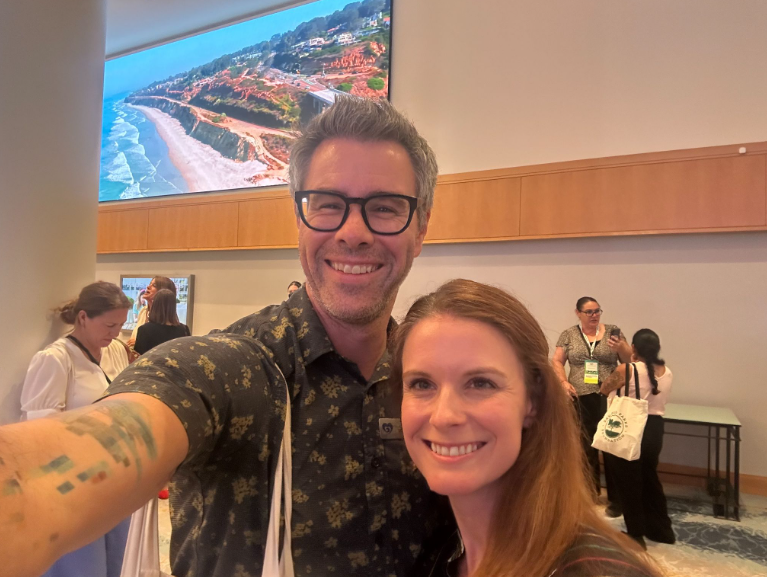
Here's a photo of Courtney and me at last week's San Diego Foundation Fundraising Conference.
We saw so many amazing people and captured exactly none of it via photo.
But hey, we were there!