
What Your Board Should Be Asking About Contributed Revenue This Fall
If your fiscal year ends December 31, next year's budget is about to land in front of your board.
And too often, here's how it gets built:
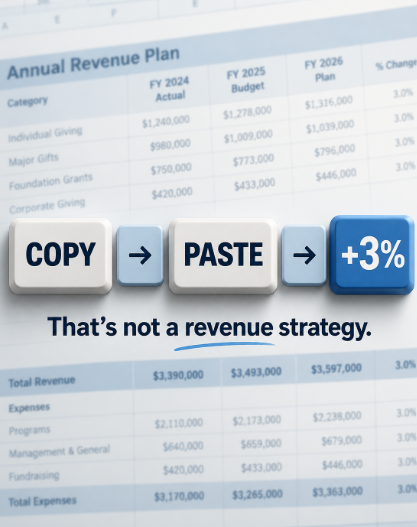
Copy this year's budget.
Raise expenses and revenue by 3% because… inflation.
Send it to the board.
Board approves.
I get it.
It's the middle of your season. Openings, the year-end appeal, the gala debrief, a grant report due Friday. If one thing on your plate can be simple, no one's going to complain.
But your budget shouldn't be simple.
It's as complicated as your organization is.
Especially on the contributed side.
Every donor has their own life going on.
A sold business. A new grandchild. A portfolio that had a rough year. A change in priorities.
When I looked at giving data from four arts organizations for my last post, three to five of each organization's top ten donors were different people than the year before.
Copying last year's number assumes last year's donors.
They won't all be there.
Grants have their own story this year, too. Federal arts funding priorities shifted, some awards were rescinded mid-cycle, and much of that money hasn't been replaced.
So maybe don't just copy and paste.
Break your revenue out by stream and look at each one on its own terms.
Major donors: Who are they? What did each give last year? How confident are you they'll give it again?
Grants: Which renewals are near-certain? Which are you hoping for?
Board giving, annual fund, gala, season sponsorships, subscribers and members: Each behaves differently and deserves its own reasoning.
The goal is a budget built from what has actually happened, with only a thin margin for the new gift or new grant you're hoping will surface.
Not because you're pessimistic.
New major donors do appear. New funders do say yes.
But a budget isn't a wish list.
It's a set of commitments.
You're contracting artists, securing rights, building sets, mounting exhibitions, and making payroll against it—often months before the revenue arrives.
None of that can wait while you scramble for a replacement grant or rush a donor ask.
And this is where your Board's role matters.
Before approving the budget, good Board members should be asking:
"Where is the revenue for this increase coming from?"
"How confident are you in each category?"
"What are we doing differently this year to get there?"
Those aren't questions to dread.
If your budget is built from real donors and real funders, you'll have the answers ready.
And your Board will leave that meeting more confident, not less.
That's what a good Contributed Revenue Plan should do: connect the numbers on the page to the actual people, funders, and fundraising strategies behind them.
What's the hardest budget question a Board member has ever asked you?
Post written by me. Graphic made with AI.