
Your Fundraising Goal Might Be Impossible
I once spent a year chasing a fundraising goal that was never achievable.
And our team was good.
Our ability to fundraise was not the issue.
New major donors came in. A longtime supporter doubled her annual gift. A five-figure sponsor showed up for the event who had never given before. Real generosity, genuinely aligned with real impact, over and over across twelve months.
Yet none of it was ever enough.
Because the goal hadn't come from our donors.
It came from a budget gap.
Expenses were growing faster than revenue, and a number was handed to development with the expectation that we would close the difference.
Peak performance from a team of fundraising experts, and the year still ended in disappointment and burnout.
Fundraising was not the problem. Understanding how fundraising works—and how to reconcile that with budget math—was the problem.
That experience has stayed with me.
Your budget should be able to tell you who is going to fund it.
If you lead an arts organization or museum building toward a January 1 fiscal-year start, here's the discipline I'd push for:
Every dollar in your contributed revenue budget should trace back to a donor or funder you can name.
Not necessarily a donor who has already committed. Not necessarily someone you know will give.
But someone whose past behavior gives you a reasonable basis for expecting a future gift.
Here's what that looks like in practice.
Someone gave $10,000 three years ago and hasn't given since.
Thank them. Ask them. Hope.
But don't put the $10,000 in your budget.
That's not an annual donor. That's a right-time, right-place giver who may come back—and if they do, that's wonderful.
But you shouldn't build your operating budget around it.
Someone has given $5,000 every year for five years.
Budget the $5,000.
Then build a real strategy to invite them to $10,000.
That's your growth opportunity, and it's sitting right there.
Someone was a steady $10,000 donor who gave $15,000 this year.
Budget $10,000—unless they told you the increase was the new normal.
If they told you it was a one-time stretch gift, believe them.
The $15,000 was wonderful. Celebrate it. Thank them for it.
But don't turn someone's extraordinary generosity into your new baseline without evidence that they intend for it to be.
Forecasting is not fortune-telling
Forecasting contributed revenue is tricky because no donor owes you a future gift.
Even a formal pledge isn't something you're realistically going to enforce in the same way you would collect an invoice from a customer.
What you're actually doing is estimating the behavior of people who choose, every year, to keep choosing you.
That means your contributed revenue budget should be built from evidence:
Who has given?
How much?
How consistently?
When did they give?
Have they increased or decreased their giving?
Are there new prospects who have a realistic path toward becoming donors?
Where are the opportunities to upgrade existing donors?
And perhaps most importantly:
What are we actually going to do to make this happen?
That's the difference between a fundraising goal and a fundraising plan.
Build the culture before you build the ask
This doesn't mean we should only ask donors for what they've given before.
Quite the opposite.
I want organizations to be ambitious about what they invite donors to do.
But ambition works best when it's rooted in a relationship.
Build a culture worth being part of—one that makes incremental annual growth feel good rather than extractive.
Then invite donors into that growth.
A donor who gave $5,000 last year might be thrilled to give $10,000 this year because they understand what that additional $5,000 makes possible.
A donor who gave $25,000 might be ready for $50,000 because you've spent time helping them see themselves as a partner in the organization's future.
That's fundraising.
But you can't manufacture those gifts by simply putting a bigger number into the budget.
When the numbers don't have a donor behind them, something breaks
When the budget can't point to who and how, it isn't a plan.
It's a hope with a deadline.
And the cost lands on people.
Staff burn out and leave.
Boards lose confidence in Executive Directors who were set up to fail.
Development teams spend the final months of the fiscal year scrambling to find money that was never realistically there.
And donors start to feel like an ATM instead of a partner.
None of that is good for fundraising.
None of it is good for the organization.
And none of it is good for the people doing the work.
Donors first. Numbers second.
I'm not arguing that budgets don't matter.
They matter enormously.
But the fundraising number needs to be grounded in fundraising reality before it gets handed to the development team as an expectation.
Build a cautiously optimistic budget.
Rally your team around how you'll actually reach it, donor by donor.
Know where the money is expected to come from, where your biggest opportunities for growth are, and where the gaps are that you'll need to solve.
Then you'll enter the new fiscal year with your Board and staff aligned on what has to happen, instead of just what has to add up.
And when your donors exceed expectations?
Be elated.
That's exactly how you should feel.
And it's exactly how any donor wants you to feel when they choose to give you more.
Everyone wins.
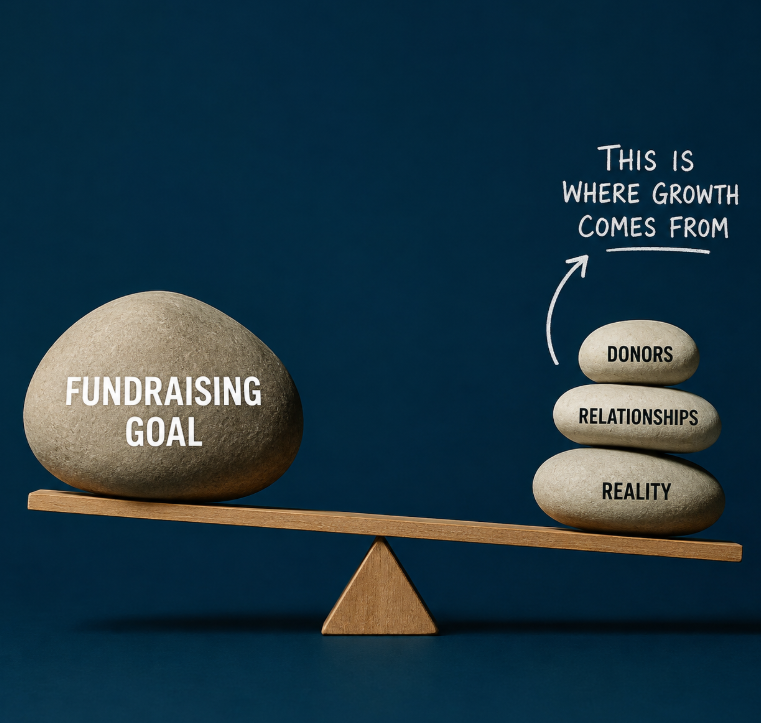
Post written by me. Conceptual image created with AI.