
Turning “No” Into the Thing Anyway
Being told no—and finding a way to do the thing anyway—has been the throughline of my entire life.
In college, I had a formative experience attending “theatre bootcamp” at the O’Neill Theatre Center’s National Theatre Institute.
It was exactly what it sounds like.
Classes from 7am–10pm.
Acting, directing, playwriting, design, movement, voice.
Seven days a week for fourteen weeks.
Two of those weeks spent in St. Petersburg, Russia.
You memorized scenes and completed assignments after 10pm.
You slept four hours a night if you were lucky.
You learned the art of the power nap—usually after lunch—just to survive the day.
It was exhausting.
It was transformative.
And it’s where I discovered the joy of directing.
The rules (and the workaround)
When I returned to my liberal arts college, I said I wanted to direct a full-length play.
I was told no.
The rules were clear:
First you direct a short scene.
Then a one-act.
Then, if you prove yourself, you can direct a full-length play.
I negotiated.
They agreed I could direct a one-act.
But I didn’t want to direct a one-act.
And neither did another student.
So we teamed up and proposed something different:
We’d co-direct a full-length play—each of us responsible for one act of a two-act show.
They said yes.
With one caveat:
We couldn’t stage it in an actual theatre.
We’d have to do it in the lobby.
Challenge accepted.
Turning a lobby into a stage
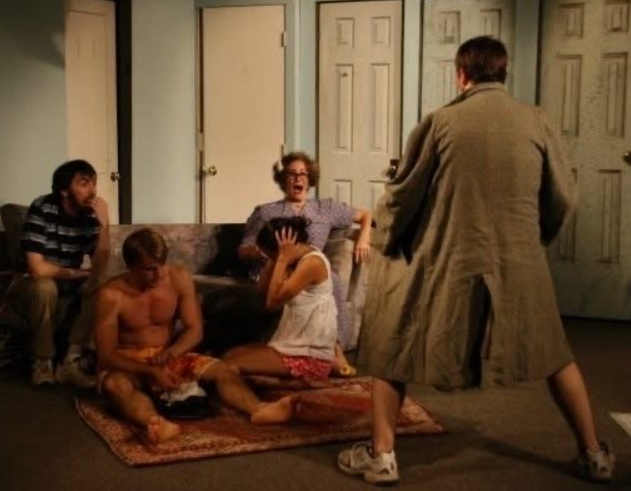
That fall, Christopher Durang’s Betty’s Summer Vacation opened at Central Connecticut State University.
We transformed a lobby into a seven-door absurdist set.
We turned a “no” into something people still talked about years later.
The production led to:
A Kennedy Center American College Theatre Festival directing nomination
A hit among our small but mighty campus theatre community
And eventually, a national award at The Kennedy Center
But none of that was the plan.
The plan was just to do the thing anyway.
It started with a no.
Why this still matters
Today, I work with Executive Directors who live in a different kind of bootcamp.
Their days are filled with:
Impossible workloads
Impossible schedules
A daily nonprofit version of triage
They take power naps when they can.
They juggle development, programs, boards, staff, and crises—often all in the same hour.
Together, we send major gift solicitations to donors.
And often, we hear no.
But here’s what I’ve learned—both in the theatre and in fundraising:
A no is rarely the end of the story.
It’s an invitation to pivot.
To rethink.
To build something more creative, more resilient, more true.
Rejection often pushes us toward solutions we never would have pursued if everything had been easy.
The arts know this better than anyone
Arts organizations, in particular, are built on this muscle.
You rehearse in borrowed spaces.
You create beauty with limited resources.
You make meaning under pressure.
And right now—when arts organizations are facing things like an 8% budget cut from the City of San Diego—that muscle matters more than ever.
Resilience isn’t optional.
Creativity isn’t a luxury.
Adaptation is survival.
So if you’re staring down a no—
From a funder, a system, a budget, or a moment that feels impossibly constrained—
I hope you remember this:
Sometimes the most extraordinary work begins the moment you’re told you can’t do it.
Stay resilient.
Turn your “no” into something extraordinary.
Caption: Ben McLaughlin, Miles Davis, Amy Lavorgna, Ashley Carvalho, and Pat Wheeler in Christopher Durang's Betty's Summer Vacation. Central Connecticut State University. September, 2008.