
A simple formula for setting year-end ask amounts, and what happened when one client put it to work.
“Will you make a gift today?”
versus
“Thank you for your gift of $250 last year. Will you make a gift of $500 today?”
The difference between those two year-end appeals is everything.
Why a specific ask works
A specific ask turns giving into a simple yes or no. The donor only has to answer two questions:
Can I afford it?
Do I want to?
Leave the amount out, and you’ve doubled their homework:
How much should I give?
How much did I give last time?
Can I afford it?
Do I want to?
Every extra question is another chance to set the letter down and “come back to it later.”
But the same ask for everyone isn’t the answer either. Some donors can give far more than others. And anyone who’s fundraised for a few years knows the flip side: a donor with capacity for a much bigger gift shouldn’t be asked for it in a mass appeal. That ask belongs in a conversation.
So how do you find the right number for each person? Here’s the approach we use.
Step 1: Total giving by calendar year
Total each donor’s giving by calendar year, 2023 through 2026. Use the calendar year, not your fiscal year, because that’s how donors think about their giving. It’s also why so many major gifts close in December, no matter when your fiscal year ends.
Step 2: Segment by giving pattern
Second Ask: gave in 2026
Renewal: gave in 2025, not yet in 2026
Lapsed: last gave in 2023 or 2024
Acquisition: never gave, or last gave before 2023
Step 3: Assign ask amounts by segment
Second Ask (based on their 2026 total so far)
$1-$200 → $50
$201-$499 → $100
$500-$999 → $250
$1,000+ → $500
This is where a matching gift makes a big difference. It gives people who already gave a real reason to give again. Name the donor (with their permission), name the amount, and set a deadline: December 31.
Renewal (one level up from their 2025 total)
Under $100 → $100
$100-$249 → $250
$250-$499 → $500
$500-$999 → $1,000
$1,000+ → Consider a personal ask instead of mail or email
Lapsed
Ask for their highest calendar-year total from 2023 or 2024. Getting them back is the win.
Acquisition
$100, or $10/month.
The art side
That’s the science. But fundraising is also an art, so scrutinize the list before anything goes out:
Adjust amounts when you know something the formula doesn’t.
Remove anyone who shouldn’t be asked right now.
Pull out the people who deserve a phone call or a visit instead of a letter.
What happened when one client used it
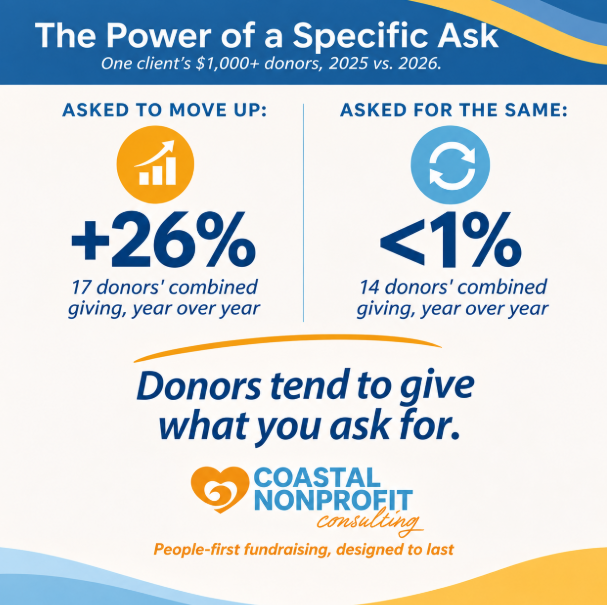
With one client this year, 17 donors who give $1,000+ were personally asked to move up a level. As a group, their giving rose 26%.
The 14 donors asked to renew at the same amount? Their combined giving rose less than 1%. Ten of them gave exactly what they gave the year before.
These were personal asks, not a mass mailing, and the people making them used judgment about who to ask for more. That’s the point: the formula gives you a starting number, and your knowledge of each donor does the rest.
The same client never ran a formal second ask, but four donors who had already given that year gave again when offered a specific reason: sponsoring tickets for an artist’s show. A clear reason to give again works.
I’ve tracked the same pattern at every organization I’ve raised money for. Donors tend to give what you ask for.
Why the no’s still count
Not everyone will say yes. They don’t need to. When you’ve brought people closer all year and you ask for something specific and reasonable, enough of them will say yes to move the needle. And a no this year isn’t wasted. You’ve planted the idea of a bigger gift for next year.
Happy year-end fundraising, friends!
If you try this with your own donor file, I’d love to hear how it goes. Just reply to this email.